
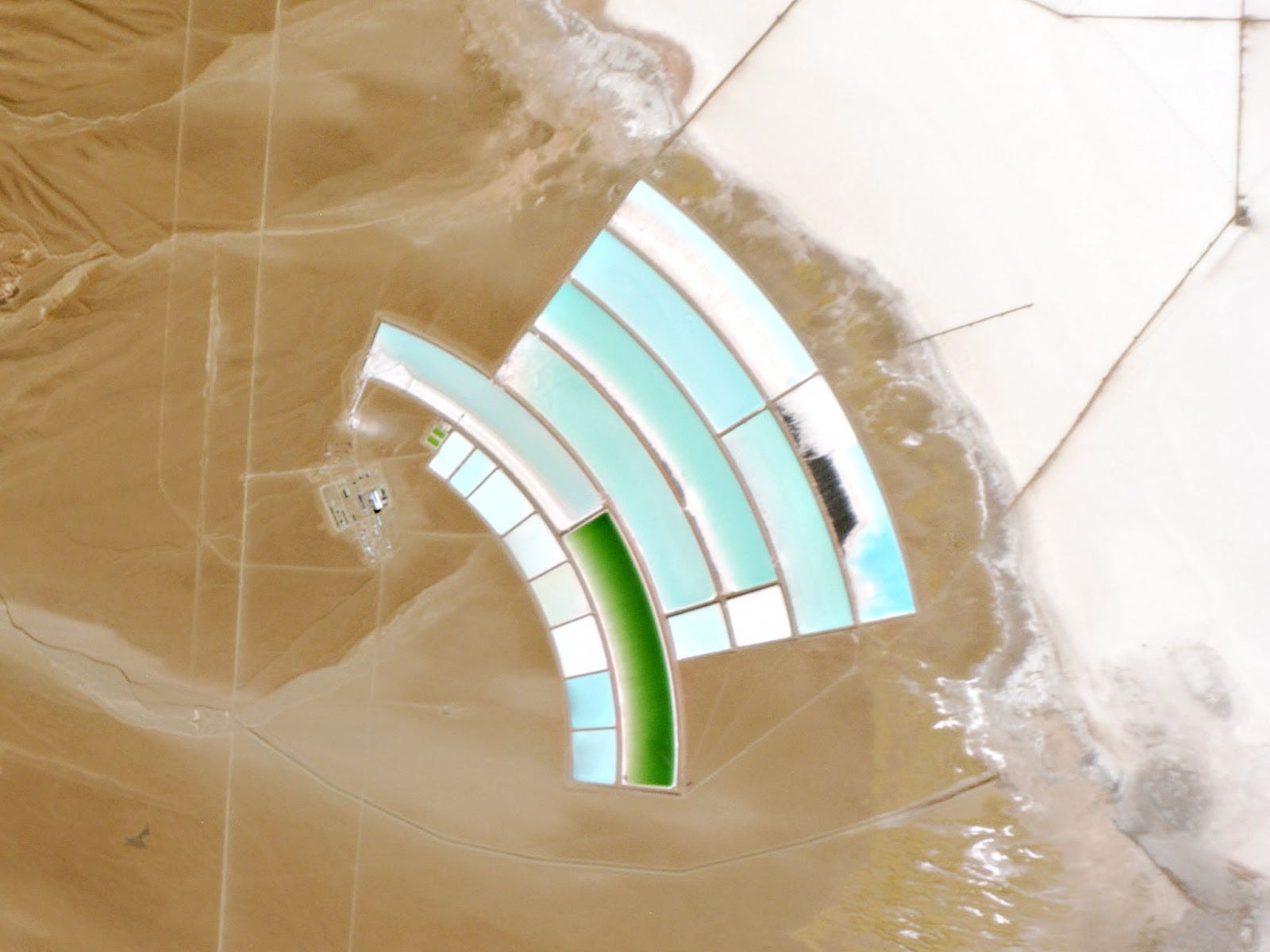
Lithium is a critical transition mineral, and its demand is expected to double or triple in the next decade. At the same time, the lithium market has been in a violent bear market since late 2022. Today, most lithium miners cannot cover their capital costs, and a big percentage of them are not even cash profitable.
Cyclical industry, in deep bear market, with producers under the water, and very good demand prospects … sounds like opportunity.
This primer covers the lithium market from the very basics – the different types of lithium exploitations and chemistries, where global production is located, geopolitics, the cost curve of the industry, its economics, and largest players– and provides a thesis on lithium economics and how its cycle might develop in the future.
My main thesis explains how the economics of lithium mining shape its cycle, why I expect it to remain highly volatile, and potential strategies to navigate it.
Disclaimer: The opinions expressed in the Blog are for general informational purposes only and are not intended to provide specific advice or recommendations for any individual or on any specific security or investment product.
Index
Executive Summary
Understanding the lithium cycle
Different plays of the lithium cycle
Appendix: Lithium basics (start here if you are new to lithium)
Appendix: Cost curves data
Other lithium articles


Executive summary
Lithium’s cycle is half natural resource, focused on cost curves and rents. It operates like other natural resource markets, such as oil or agricultural commodities. Some producers enjoy natural cost advantages that make them profitable across the cycle, while others only survive when prices are high.
The Lithium Triangle sets the floor, hydroxide sets the volatility. Brine-carbonate producers in Argentina and Chile form the low-cost base of the market. Spodumene-hydroxide producers, on the other hand, are the marginal players—coming and going with price swings.
Unlike oil and agriculture, lithium lacks marginal flexibility. Whereas in oil and agriculture, the marginal producer is flexible and relatively capital-light —shale oil or marginal agricultural lands can be brought to production in months and have relatively low fixed costs—in lithium, the marginal producer has significant barriers to supply adjustment, as it is a capital-heavy chemical processing industry.
Lithium’s cycle is half chemicals because of supply rigidity. Bear markets don’t clear fast since high fixed costs push marginal producers to keep operating at a loss, while bull markets face delays in expanding capacity. This is classic chemical industry dynamics.
Focus on cost-advantaged, unlevered assets during bear markets. This tends to be a good strategy for volatile chemical industries. Unfortunately, options are limited—Rio Tinto is already locked in the best Argentine brine assets, and the largest Chilean brine producer will see state-mandated equity dilution after 2030. Australian spodumene is worth considering if hydroxide and carbonate prices diverge significantly. Otherwise, their marginal status makes them a risky bet. Hydroxide processors – integrated or not – are the weakest link in the chain and will function as the profitability buffer of the industry.
Understanding the lithium cycle
The thesis comes first: how lithium mining economics shape its cycle, why I expect high volatility to persist, and the best ways to play it. This section is straight to the point and assumes some market knowledge.
For those less familiar with lithium, an Lithium Basics section in the Appendix covers the fundamentals from the ground up.
Using a supply framework to understand lithium
Three factors regulate the cycle of a commodity. First, the cost position of each producer. Second, the speed with which production can be increased or decreased. Third, the increment of supply adjustments. All else being equal, the longer it takes to remove/increase supply, and the larger the increment in which supply changes, the more violently the cycle will move around the equilibrium. Conversely, in a fast production cycle and marginal increment industries, prices will cycle closely to equilibrium.
I use a supply-driven framework for cyclical commodities, which I explain in detail in an article with various applications and examples. Here, I provide a brief summary and specifically apply it to the lithium market.
Commodity demand is relatively fixed and price inelastic in the medium term. People won’t consume twice as much oil because it’s cheaper or halve their food intake because it’s expensive. ALithium demand, while expected to grow significantly, is also inelastic—it follows a pull model driven by EV and battery demand, where lithium costs matter but aren’t the primary driver.
In a market where demand is exogenous (independent of price), price is determined by the abundance or lack of supply. When supply exceeds demand, prices will tend to decrease, and marginal producers will become unprofitable. Eventually, these producers will leave the market, and prices will rise again. Which producers enter or leave the market and where the approximate equilibrium price is depends on the cost curve of the commodity producers.
Supply adjustment dynamics shape price cycles. Two factors influence this: (1) the speed at which production can be increased or decreased, and (2) the scale of supply adjustments. The longer it takes to adjust supply and the larger the increments in which it changes, the more volatile the cycle. Conversely, in industries with rapid supply adjustments and small increments, prices track equilibrium more closely.
Lithium’s cost curve: brine-carbonate advantage
The first factor in modeling the lithium cycle is the cost curve, which represents the profitable supply at different price levels. The general consensus is that brine-carbonate integrated producers in the Lithium Triangle (Argentina and Chile) sit at the low end of the cost curve, able to operate profitably at or below $10/kgLCE. In contrast, the spodumene-hydroxide producers are the marginal cost suppliers, with costs ranging from $12 to $15/kgLCE.
I have compiled cost curves from various sources (refer to the Appendix: Cost Curves). While estimates vary, a picture emerges:
Brine carbonates producers, particularly in Argentinaand then in Chile, hold a significant cost advantage over Australian spodumene and hydroxide producers. Estimates suggest that brine-carbonate operations can be profitable around $10/kgLCE now, including capital and royalties ($5/7k without taxes) with potential future all-in costs as low as $8/kgLCE. In contrast, most integrated hydroxide require prices of $12/15k/kgLCE to break even.
The lowest-cost Argentinian brine projects have not hit the market with scale yet. Meanwhile, non-integrated spodumene miners in Australia have a capital breakeven of $1/kg of spodumene concentrate, equating to $7.5/kg of spodumene inputs per LCE. Whether they remain viable at $10/kgLCE prices depends on hydroxide processing margins, which will fluctuate independently of spodumene margins.
There is less information about hydroxide-processing breakeven margins —the difference between spodumene inputs and hydroxide outputs—but at current prices, most independent hydroxide capacity is under the water.
Most miners, especially integrated spod-hydro, are not cash-profitable at current prices and have little capacity to continue investing.
Barriers to supply-adjustment in lithium
How producers react to being under or over the water depends on how easily they can adjust supply, which is constrained by operational, cost, capital, and resource availability factors. In lithium, both brine-carbonate and spodumene-hydroxide have barriers to adjustment, mainly in the chemical processing stage, adding volatility to the cycle.
Lithium Reserves Can Sustain Decades of Demand, Limiting the Need for New Resources
The first requirement for expanding a commodity's supply is identifying economically viable extraction sites.
The IEA calculates that by 2030, the world will need about 500 thousand tons of lithium content (or 2.5M tons of LCE) per year under current green commitments. The USGS believes the world now has 30 million tons of lithium content of reserves (60 years of supply) and 115 million tons of resources (230 years). The resource is abundant in proven economically profitable exploitation. There is not much need to look for more resources (a process that can take a decade in the case of brine).
This is true for both brine and hard rocks. Arcadium lithium (Argentinian brines) believes it has more than a century of resources (not reserves) at planned production rates (Investor Day 2024). Fastmarket believes the Atacama desert in Chile has reserves of 9.2 million tonnes of lithium mineral (50 million tonnes of LCE, or 25 years of 2030 consumption). In spodumene, the Greenbushes mine has almost 8 million tonnes of LCE 2023 reserves (IGO), Pilgangoora another 6 million (2.5 million Li2O Pilbara), and Wodgina another 4.5 million (ASX).
As a result, the largest lithium producers will not need to go look for new resources any time soon.
Brine-Carbonate Supply Faces Adjustment Barriers, but Its Low Costs Limit Their Impact
The first limiting factor in brine-carbonate producers is physical. Brines are deposited on large pools to naturally evaporate and condense the desired lithium salts (LiCl). This process depends on the evaporation rate (the humidity of the ambient) and takes about 18 months in the best locations (Lithium Triangle). Thus, today’s supply is constrained by decisions that are at least 18 months old. In the next 5 to 10 years, direct lithium extraction could shorten this timeline with minimal additional cost. (Goldman Sachs).
The second factor is capital. Brine operations are generally integrated, including the pools that convert brine to lithium chloride and the processing capacity that converts chloride into carbonate. The capital cost per tonne of lithium capacity is high, especially in processing. This is a barrier to supply expansion during bear markets. Goldman Sachs calculates that capacity can be added in increments of $300 million per 10-15 thousand tonnes of lithium carbonate per annum. Of these, more than half of the CAPEX is needed for processing. This means a medium to large-scale brine-carbonate project (50 thousand tonnes, or 2% of demand in 2030) can cost upwards of $1 billion.
Finally, brine-carbonate operations have an incentive to dilute costs and drive economies of scale. This is true in brine pools, where the variable costs are relatively low, where most energy comes from the sun evaporating the water, and in chemical processing, where chemical plants need to operate close to nameplate capacity to achieve efficiencies.
Spodumene-hydroxide barriers mostly in processing
Once established, spodumene mines can vary capacity with relative ease, given capital costs are not substantial, and variable costs play a bigger role. However, the processing into hydroxide is capital-intensive and therefore benefits from scale, making adjustments more difficult.
Spodumene is mined in open pits, which have high variable costs (blasting, trucking, early processing), but not so large capital costs, once the resource has been discovered and feasibility established. Small brine projects can cost as little as $100 million for 30 thousand tonnes LCE of spodumene concentrate (Sigma) or $250 million for 22 thousand tonnes LCE of spodumene concentrate (Lithium Ionic). In an established mine like Greenbushes, a 500 thousand tonne/year spodumene concentrate processing plant (~66 thousand tonnes LCE) costs about $560 million (Mining Weekly). These are large costs, $3 to $8 thousand per tonne of LCE capacity, but not the $20/30 thousand of integrated brine-carbonate.
With lower capital costs, there is a lower drive for adding volumes to dilute the fixed costs. The spodumene cost curve is at least 50%+ variable cash costs (cited from Citi). Again, this allows for faster short to medium-term adjustments.
Similarly to brine-carbonate, the main barriers are in chemical processing. First, the capital costs are much more significant. Plants can cost $1 to $1.5 billion for 50 thousand tonnes of LCE (Albemarle, Piedmont). Higher capital costs add an incentive to operate at higher volumes (adjustment barrier). Another barrier is that chemical processing generally needs to operate at nameplate capacity. We have seen more mothballing of capacity than operations at lower utilization rates.
Finally, a factor adding to structural overcapacity (impeding downward adjustments) in hydroxide processing is geopolitics. The US-China conflict leads each camp and its allies to see lithium downstream processing as a strategic capacity. Therefore, market forces will not be the only determinant in adding/closing capacity. This has probably been a factor in the Australian spodumene miner push to integration downstream, with terrible economic consequences for the miners, when the model pre-2020 was for Australia to export spodumene concentrate without processing. In carbonate processing, the capacity countries are more neutral.
Hydroxide and carbonate supply chains are not perfect substitutes
Carbonate and hydroxide battery chemistries are suited for different uses, and although one can convert carbonate to hydroxide and vice versa, the process is expensive. If the products have different demand sources and there is little capacity for conversion from one into the other, it is possible that during bear markets, hydroxide prices decouple from carbonate prices to the upside.
Lithium chemistries are not full substitutes. LFP batteries derived from carbonate are less expensive and more suitable for price-sensitive applications in mass transport (trucking, taxis, public transport, low-cost EVs) and grid storage. NCM batteries from hydroxide are more expensive but adapt better to the needs of more premium vehicles like fast charging and longer ranges.
Carbonate can be converted to hydroxide. Arcadium-Rio Tinto (Argentina) and SQM (Chile) both have carbonate to hydroxide capacity. However, costs add up and a competitive carbonate producer might not competitively convert to hydroxide at current prices. Hydroxide to competitive carbonate is even more unlikely.
Cycle-dynamics
I think lithium prices will have strong pressure to move to an equilibrium close to carbonate production costs that leave integrated hydroxide under the water. In the battle between hydroxide processing and spodumene, I think the latter has a higher chance of being profitable. This will probably lead to cyclical under-capacity in hydroxide processing, which will add volatility to the whole cycle. Over time, the two markets might dislocate unless there’s strong carbonate to hydroxide conversion capacity.
We can start by finding the equilibrium.
Because integrated carbonate producers are profitable (including capital costs) at prices close to $10/kg LCE and potentially lower over time, there will be a strong incentive for prices to move close to that level over time. The reason is simple: at prices above $10/kg, carbonate producers have incentives and funds from operations to expand production.
At $10/kg, however, integrated spodumene-hydroxide is not capital or even cash profitable. Because hydroxide processing plants need to run at full capacity, they tend to lose margin more rapidly than spodumene producers (willing to take spodumene at higher prices). This leads to particular pressure on hydroxide producers. (Albemarle 4Q24 call: Non-integrated hard rock conversion remains unprofitable, and larger integrated producers are facing pressure (...) Management estimates roughly half of that 25% has already curtailed or reduced utilization).
The producers that are cash-but-not-capital profitable will not decrease production but will not expand capacity. The producers that are cash-unprofitable will close down production. This can eventually create conditions for undersupply in lithium hydroxide, either because supply leaves the market or because it does not grow as fast as demand.
Therefore, the actual equilibrium has to be somewhere between $10/kg (where carbonate producers will push the price) and $15/kg (where most integrated hydroxide is profitable).
How low and how high can the cycle go?
In the lower bound, carbonate producers also have incentives to produce below $10/kg, and potentially even as low as $8/kg or below, because they can recover their (low) cash costs and dilute their overhead. However, it is unlikely that they will expand capacity at those prices. Further, at $8/kg, the pressure on the hydroxide chain would be massive, leading to either a dislocation of the carbonate-hydroxide markets or large closures. Therefore, lithium prices can go as low as $8/kg, but this is not sustainable over the mid-term.
Lithium prices during a bull market in lithium can go significantly above equilibrium, as seen in the 2021 bull market. They can probably stay significantly above the equilibrium for one or two years in the bull cycle as well because that is the time required to bring new chemical processing capacity (hydroxide or carbonate) and even new brine capacity in the limit.
Because of the adjustment barriers presented by chemical processing, I would expect the cycle to be volatile and very rarely remain close to equilibrium prices. Between $11/kg and $15/kg, carbonate and hydroxide producers are very motivated to expand capacity, leading to prices below that range and lower hydroxide investment. When demand surpasses supply, the adjustment to the upside will be slow, meaning prices will overshoot.
Factors that can moderate the cycle include direct-lithium extraction technology (shortening the delay between brine and lithium chloride from months to days and making brine more ‘variable-price’ sensitive) and carbonate to hydroxide production (allowing brine producers to expand their market substantially).
Different plays of the lithium cycle
The basic strategy: low-cost, unlevered producers during the bust
My framework for cyclical industries is trying to find producers at very attractive cycle-average earnings yields (20/30% yields on market cap or EV), low costs (profitable even in downturns), and minimal financial leverage (ideally fixed, cheap, and long-term). More on this in my Cyclicals Framework.
Rio Tinto snapped the best Argentinian assets
Argentina sits at the bottom of the cost-curve because it has lower taxes than Chile. Unfortunately, there is no pure-play on those assets. Arcadium is being acquired by Rio Tinto and Ganfeng is deeply in the red because of its hydroxide assets.
Arcadium is in the final stages of being acquired by Rio Tinto and will be delisted. Interestingly, the only mining major to participate in lithium decided to acquire the lowest-cost assets. Even more interesting, Rio Tinto has massive operations in Western Australia, with potential synergies with spodumene, but decided not to participate in that market.
Ganfeng (more details below) is a large Chinese conglomerate very concentrated in hydroxide processing in China. For that reason, it is deeply in the red.
Chile’s SQM will cede control of Atacama after 2030
The second best assets are in Chile’s Atacama desert, and SQM has the largest operation there. Unfortunately, the company’s concessions over the resource end in 2030. After 2030, operations will be taken over by an SQM/Government JV, with government control of the Board. SQM will own 20% of the margin over $7/kgLCE after that.
SQM has the largest currently profitable operation in the world (Argentina’s assets are still under development in many areas). It has low fixed-rate debt and little dilution into non-Chile assets (mine JVs in Australia, hydroxide processing in China, but small).
Unfortunately, SQM’s assets are based on concessions with quotas ending in 2030. The company renegotiated participation post-2030, but only at the cost of forming a 50/50 JV with the government ceding operational control.
CodelCo, the Chilean government copper miner, will control the JV. The company has extensive operations in mining (world’s largest copper producer). Based on a release by SQM (link), after 2030, SQM will have the right to about 20% of the margin over costs pre-royalties (of about $6/7k per tonne of LCE).
This means in a $10k LCE scenario, the company receives about $700/tonne after taxes, and based on 300k tonne LCE production, net profits of $210 million. In a $15k/tonne scenario, the profits are about $510 million.
These equations could change if the royalties are reduced for the JV, which is unclear and would be detrimental to the state (and therefore unlikely). Still, it seems difficult to justify a $10.6 billion valuation under these scenarios.
Albemarle is sagged by hydroxide processing
Albemarle owns 50% of Australia's most competitive spodumene mine (Greenbushes), which continues to be profitable as of 4Q24. Albemarle also has a Chilean-brine concession in Atacama (same as SQM) that lasts until 2044 or ~ 2.5M tonnes of LCE. However, the company is over-invested in hydroxide processing, and its capital structure is not strong.
Albemarle has access to two of the best assets in the world.
It owns 50% of the Greenbushes mine in Western Australia, the largest in the world, potentially the best grade, and, for that reason, the cheapest per tonne of spodumene concentrate. This mine is still profitable as of 4Q24 and even 3Q24, with spodumene prices of $800/1,000 per tonne of concentrate.
The company also has a concession in Atacama, Chile, for a total of 2.5 million tonnes of LCE until 2044. The Chilean state can still charge very high royalties and taxes on this mine (potentially 60/70% of the margin), but the unit costs are very good if they are comparable to SQM above ($6/7k per tonne of LCE before royalties and taxes).
However, Albemarle has two problems.
First, it has over-invested in hydroxide processing capacity, which is the worst market segment, at least at current prices. The company had planned four trains on its Kemmerton facility but had to cancel two of them and put another in care and maintenance at a $1 billion impairment charge. This indicates a poor cycle reading, as the company funneled cash flow from the 2021/22/23 bull into these projects without forecasting the upcoming glut. It could also be that the company was pressured politically, given that most of the Australian spodumene was sent for processing to China, leading to some raised eyebrows in terms of supply chain security.
Second, and related, the company is now levered at the bottom of the cycle and bleeding cash at these prices. As of 4Q24, the company had $1.1 billion in cash against $3 billion in debt and $2.2 billion in convertible preferred shares (strike $110/140), yielding 7.5%. The company generates an adjusted EBITDA of $1 billion per year at current prices, so we are talking about 4/5x net debt plus preferreds to EBITDA. Interest and preferred dividends are well covered (~$350 million), but this is still a challenging outlook.
Albemarle is pulling off some desperate measures because of this position. First, the preferred shares were in May 2024, and then, $350 million in customer pre-payments were obtained for a five-year contract for spodumene in 4Q24.
I don’t think Albermarle meets my rules of low-cost assets (partially meets), good capital allocation (does not meet), and unlevered (does not meet).
Chinese producers are focused on hydroxide and deep in the red
Two large Chinese players in lithium are Ganfeng and Tianqi, with participations in brine assets in Argentina and Chile (Tianqi owns 20% of SQM, Ganfeng owns projects in Argentina and partners with Arcadium in others) and Australia (Tianqi owns 25% of Greenbushes, Ganfeng participates in Mineral Resources and Pilbara operations).
However, these two players are the most concentrated in hydroxide processing. This has obviously led them deep into operational losses. Ganfeng reported net losses (ex impairments) of CNY 500 million for 9M24 (on sales of CNY 13 billion), and Tianqi reported losses to shareholders of the parent company of CNY 5.7 billion.
Australian spodumene is too diversified
Besides Albemarle, there are two important projects in Australia, Pilbara Minerals and Mineral Resources.
Mineral Resources is diversified into iron and mining services (engineering and construction). Lithium represented about 25% of revenues only, and in the three JVs (Mt Marion, Wodgina, and Bald Hill), FOB prices were above $800/900 per tonne of spodumene concentrate (versus current prices of about that CIF China).
Pilbara Minerals claims a better cost equation (FOB $680/tonne,) but as of 2H24 calendar, it cannot cover sustaining CAPEX anymore. Further, it has started to diversify away from cheap spodumene. It is opening a hydroxide JV with POSCO in Korea, and considering another one with Ganfeng in China. It has also bought a spodumene asset in Brazil
Conclusions
Lithium has an interesting cycle, which is a mix of a natural resource cycle – cost-curve and rent-driven – with a chemical one – capacity-driven. In the natural resources markets, with lower volatility, it is more difficult to find assets on the cheap. Lithium, with higher volatility, offers that opportunity.
Unfortunately, I don’t think any of the plays of the current cycle are particularly exciting. The best assets in Argentina have been acquired by Rio Tinto, and in Chile new concessions have much less attractive terms. Australian assets are less competitive or sagged with unprofitable hydroxide processing capacity.
Not having an opportunity now is not terrible. Companies come and go, and new developments in technology and demand change the nature of the cycle. There might be better opportunities in lithium in the future.
Appendix: Lithium basics
The idea of this appendix is to provide the basics to understand lithium demand and supply: why is it demanded, and how it is obtained. To make it synthetic, it will consist mostly of affirmations like ‘all EV battery chemistries require lithium’ without an explanation. You can find them on your own in case you are doubtful.
Lithium demand
Lithium is the essential element of all existing EV battery chemistries, and there is no replacement for it. EVs are necessary for the energy transition, which governments push because of the climate crisis and geopolitical reasons. Lithium is the least developed supply chain of the ‘transition-minerals’, and its demand is expected to be 3x by 2030 and 10x by 2040.
Lithium forms the basis of all battery chemistries for EV applications. Currently, no battery chemistry would work for EVs that do not require lithium.
Almost all current and future lithium demand comes from EVs. It is also used for grid-level batteries, but in this arena, sodium-ion batteries are potentially much more competitive (much cheaper, and their higher weight is not an inconvenience as in the case of EVs).
EVs are a critical component of the energy transition (abandonment of fossil fuels), which is being pushed by countries for environmental AND (big AND) geopolitical reasons (energy sufficiency and security). This means lithium demand is very dependent on political support for the energy transition.
Lithium is the least developed of the ‘transition-minerals’ (copper, nickel, cobalt, graphite) with demand expected to 3x by 2030 and 10x by 2040 (IEA).
Lithium supply chains
Lithium can be obtained from brines or mined. Brines are abundant but only economically obtainable from three sources (Arg/Chile, China, US), at least until DLE technology. Rocks are much more abundant. Brines are processed into lithium carbonate generally in the source, and rocks into hydroxide, in many locations but very concentrated in China. Each of these materials is preferred for some battery types and not others. The materials are processed into batteries, an area where a handful of Chinese companies are super dominant.
Brines-carbonate
The cheapest way to obtain lithium is by evaporating brines rich in lithium into lithium chloride and then precipitating that chloride into lithium carbonate. This method is responsible for about 50% of world lithium production. The process is not complex in either evaporation or processing but is limited naturally because only a few regions in the world are sufficiently dry (Argentina/Chile/Bolivia Andean Plateau, Tibetan Plateau in China, Great Bassin Desert in the US). Even in these cases, it may take 12/24 months of evaporation.
Another factor affecting brine quality is purity, mainly the lack of magnesium, because purification is arguably the most challenging part of chemical processing.
Prospecting and developing a brine project can take up to a decade because of the need to adapt the evaporation process to the chemistry of the brine (considering each ‘test run’ takes 12/24 months).
Direct Lithium Extraction
Direct lithium extraction (DLE) is a technology that could revolutionize brine lithium in two ways: a) allow brine extraction in humid climates, multiplying the economic resource; b) allow the producer to define production in a window of days/weeks instead of months/years.
There are several DLE technologies, none of which is substantial yet, and each needs tinkering for a particular brine chemistry. Still, the consensus is that DLE will add brine resources globally within 5/10 years at competitive rates with brine-evaporation projects.
Hard rock (spodumene, lepidolite) - hydroxide
The second method for obtaining lithium is to mine rocks rich in lithium oxide, like spodumene and lepidolite (collectively called hard rocks). Hard-rock deposits are relatively abundant, with production currently concentrated in Australia, China, and Africa (Zimbabwe, DRC, Ghana) but important developments in Brazil, the US, and potentially Peru and even Europe.
The rock concentrate (enriched from ½% to ⅚% lithium oxide) is then processed into lithium hydroxide. The processing of lithium oxide into hydroxide is more complex than that of lithium chloride into carbonate. It requires roasting, leaching, precipitation, and crystallization versus basic precipitation for brines.
Carbonate-hydroxide conversion
Carbonate can be converted into hydroxide and vice-versa. It is easier to go from hydroxide to carbonate than the other way around, but given the economics of lithium, only carbonate to hydroxide is an industrialized process. Arcadium and SQM, the two largest brine producers (both in Lithium Triangle), have global carbonate-hydroxide capacity in the US, China, and Japan (Arcadium) and in Chile (SQM). Lithium hydroxide from carbonates is not competitive with lithium hydroxide from hard rocks.
Battery types and manufacturing
Carbonate and hydroxide do not go directly into batteries. They require further purification and processing, but they are the preferred inputs to the battery manufacturing process.
Carbonates are preferred for the manufacturing of lithium ferro-phosphate (LFP) batteries, which are more durable and cheaper but slower to charge and less dense (lower battery range). They are also safer (lower risk of fire). These batteries are preferred for cheaper EVs, settings with convenient battery swaps like public transport, trucking, and taxi fleets, and grid-level batteries.
Hydroxides are preferred as inputs for the manufacturing of nickel-cobalt-manganese (NCM) batteries. These batteries are less durable and more fire-hazardous but have higher ranges and charging speeds. They are mostly preferred for premium EVs.
A few years ago, it was believed that hydroxide would be in more demand than carbonate because of NMC’s range-speed advantages. However, LFP batteries have shown that they have not only better costs but potentially also better logistics (battery swapping instead of charging).
Appendix: Cost curves
These are some of the sources I used to estimate the lithium cost curve.
General
A report from Goldman Sachs, cited by ZeroHedge, puts both South American brine and Australian spodumene at below $8k/t cash costs, very close together in price, with almost no difference in cash costs.
Albemarle (slide 29) says that by 2030, 75% of lithium production will be under the water with a price below $15k LCE
Albemarle said on its 4Q24 call that ‘Non-integrated hard rock conversion remains unprofitable and larger integrated producers are facing pressure. Our estimates of pressure on the global cost curve are unchanged. We think that at least 25% of the global resource cost curve is either at or below breakeven.’
The Oxford Institute of Energy cites Benchmark Minerals for a cost curve (no mention of whether it is cash or all-in) where 75% of production is below $10k per ton of ‘lithium chemical’ (no mention of which).
Goldman Sachs (exhibit 12, using Woodmac estimates) puts brine production in the lithium triangle as a cash cost of ~$3.5k/tLCE by 2028. If we add capital costs of ~$30k/tLCE, spread over 20 years (same report), and a 15% IRR cost, we arrive at $6k, plus or minus 20% for taxes and royalties. This contradicts the above from Goldman as well but also considers 2028 production, so more cost efficiencies.
For spodumene and hydroxide, Citi puts the Greenbushes mine (Albemarle, Tianqi), at about $600/tonne of concentrate, or about $7.5k/t of lithium hydroxide (assuming 7.5 tons of spod concentrate per ton of hydroxide, and $3k of processing per Piedmont). The rest of the spodumene producers have costs of about $900/t of concentrate or $10k/t of hydroxide. These figures include capital costs. This is consistent with figures from Mineral Resources and Pilbara Minerals.
This is an extremely well thought through primer and I thank you as it was what I was looking for.
I'm coming at this from the perspective of considering an investment in Pilbara Minerals or PLS (I'm an Australian). But I'm still trying to wrap my head around the whole geography and this is just a way for me to clarify my own thoughts based on your primer! Feel free to correct anything that's not correct!
Lithium is not especially rare and current proven reserves are likely to be more than enough to meet anticipated demand for a long time to come.
You are saying Lithium carbonate and hydroxide are not interchangeable without some cost and have different applications with hydroxide being the more premium material. There is the possibility the two markets could dislocate as currently the economics of carbonate to hydroxide do not make sense.
The overall backdrop to the current lithium market/price is that recent high prices and higher real and anticipated demand has led to overcapacity in production and a bear market. Additionally there is a view that China is flooding the market with cheap lithium that's partially state subsidized in order to maintain its dominant position.
With regards to the last point I'm unsure what role this will continue to play? Since China is the main producer of lithium batteries I am also unsure to what extent they can satisfy their own demand from domestic reserves now or in the future?
The pricing is a little complicated as much of production is sold on contract rather than on public markets and varies by region and presumably transport costs to its final destination?
There also the issue of competing battery chemistry with iron ore devotees like Robert Friedland who are not believers in lithium - but since it is one of the lightest minerals on the periodic table this seems overstated.
What this means for PLS:
Specifically ,PLS has no debt so it meets your very sensible criteria of being unlevered which due to the cyclical nature of commodities and lithium is a big thumbs up.
Greenbushes which is the best hydroxide mine in the world has costs of about $600 per tonne of concentrate (or $7.5k per ton of hydroxide). In comparison PLS which has the second best hydroxide mine in the world has costs of about $680 per tonne.
PLS says they need $1400 a tonne to make money, current level is $700 a tonne so they are barely cash flow neutral and not certainly not capital profitable. But they have no debt so if there is not any further decrease in the price they can survive the squeeze? You think the price will settle out between $1000-$1500 a tonne.
PLS does not produce any lithium hydroxide in Australia, they have recently entered a JV in Korea to send their concentrate to. Due to the nature of the market hydroxide processors will always be the first to get squeezed as carbonate is cheaper you are saying. It's a fairly small 18% per cent investment - probably not material.
PLS has made a relatively small investment in hard rock miner in Brazil which seems a little bonkers since you've got all this cheap carbonate coming out of South America but its been done at probably a good price. Not that material anyway if it goes tits up as we like to say here in Australia.
I dunno man - Buffet stays away from these types of businesses is my first thought!! Too many unknowns, I don't think there will be a problem on the demand side in the long term but who knows what China will do, who knows about battery chemistry, who knows about processing technology re carbonates which have a cost advantage and if the upside is $1500 a tonne it's not really enough?
Thank you!! I'm very grateful for your primer, it may have helped me avoid a costly mistake and will look to become a subscriber!