

BTG Pactual (BTG for simplicity) sits at the center of the Brazilian capital markets. It is the largest investment bank and trading desk, one of the largest asset and wealth managers, and is now also one of the largest corporate lenders in the country.
The company caught my attention because it sports a 15-year average ROE of 20%, currently at 25%, has been growing at 20%+ clips throughout the post-pandemic, and trades at a PE of 15x.
Last week, I used BTG as an example in an article (still free to read) to illustrate how investor returns are modified based on a company’s PE (or PB) multiples and the company’s capital allocation decisions, principally distribute or invest.

In that article, the conclusion was that as long as BTG’s incremental ROE is larger than its earnings yield (~6.5% at 15x PE), then it should dedicate most of its profits to investing.
The company is following that direction, with a dividend payout ratio of 25%, implying reinvestment of 75% of earnings.
Finding new avenues for that kind of growth can get challenging for a bank creating $3/4 billion (R$15/20 billion) in yearly equity, and levering at 10x on its balance sheet.
This article focuses on just that: where the company can invest capital, where it can grow without capital, what incremental ROEs could look like, etc. Along with that, we can understand the company a little better and evaluate it as an investment.
Hope you like it, and vamos!
Disclaimer: The opinions expressed in the Blog are for general informational purposes only and are not intended to provide specific advice or recommendations for any individual or on any specific security or investment product. I may own or later purchase some of the stocks mentioned in this article.
All models and spreadsheets used in this article are available for Premier Tier users.
Paid subscribers get access to TLDR and summaries.
BTG Pactual intro
Pactual was born in the 1980s as a securities trading firm and broker. By the 1990s, it had expanded to asset and wealth management and investment banking. It was temporarily acquired by UBS in 2006. A group of Pactual partners then left to create BTG, an alternative asset manager, which ended up acquiring UBS Pactual in 2009 to form BTG Pactual.
The bank today is a mix of investment bank (asset and wealth management, sales and trading, investment banking), with credit, particularly corporate, and Treasury. Although it naturally has offices in the main financial centers and expanded its investment franchises to South America, it remains a squarely Brazil-focused business.
The bank continues to function as a partnership, through a control holding still owning ~65% of the bank’s shares. Partners allocate themselves through the control holding, without affecting the bank’s shares.
Bankification and leverage
Like many other financial and capital market service companies in Brazil, BTG has gone through a process of bankification since the pandemic (for more on this, check my Brazilian Banks and Brazilian Capital Markets primers).


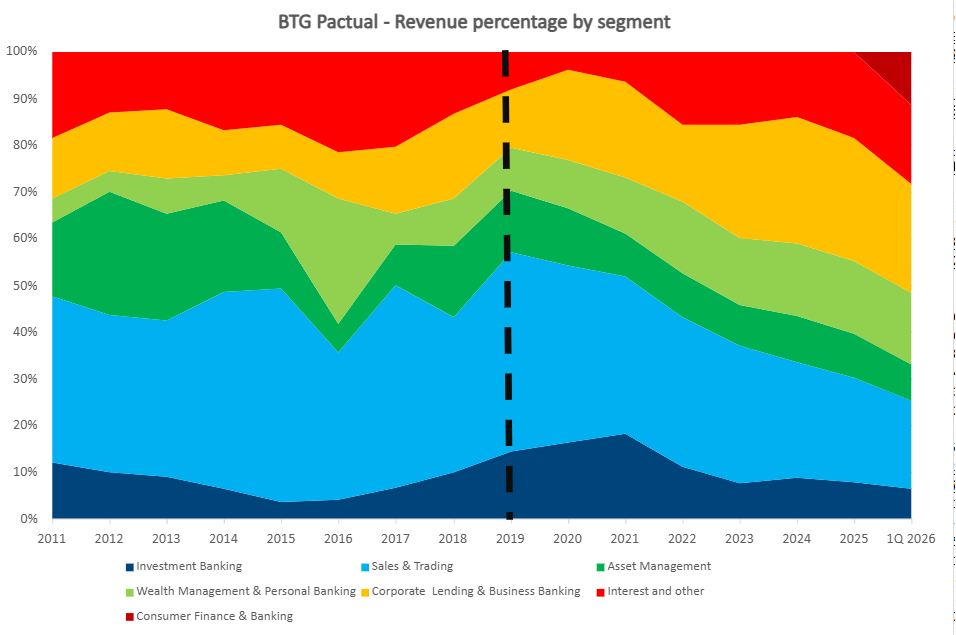
The chart below illustrates it very clearly. Until 2019, 50% of the bank’s revenues came from brokerage and investment banking, and another 20/30% from asset and wealth management. Until the pandemic, BTG was primarily about investments. Since then, the bank’s lending and treasury functions have expanded to account for 50% of revenues (in all cases, reported net of funding costs). Since the pandemic, it is half investment, half bank proper, and the trend continues.
Who could blame them? In a country that has sported inflation-adjusted rates of close to 10% for around five years now, it is natural that companies will turn to lending activities. Further, and very relevant for this analysis, lending and treasury can absorb capital, whereas most investment activities (except for sales and trading) cannot.
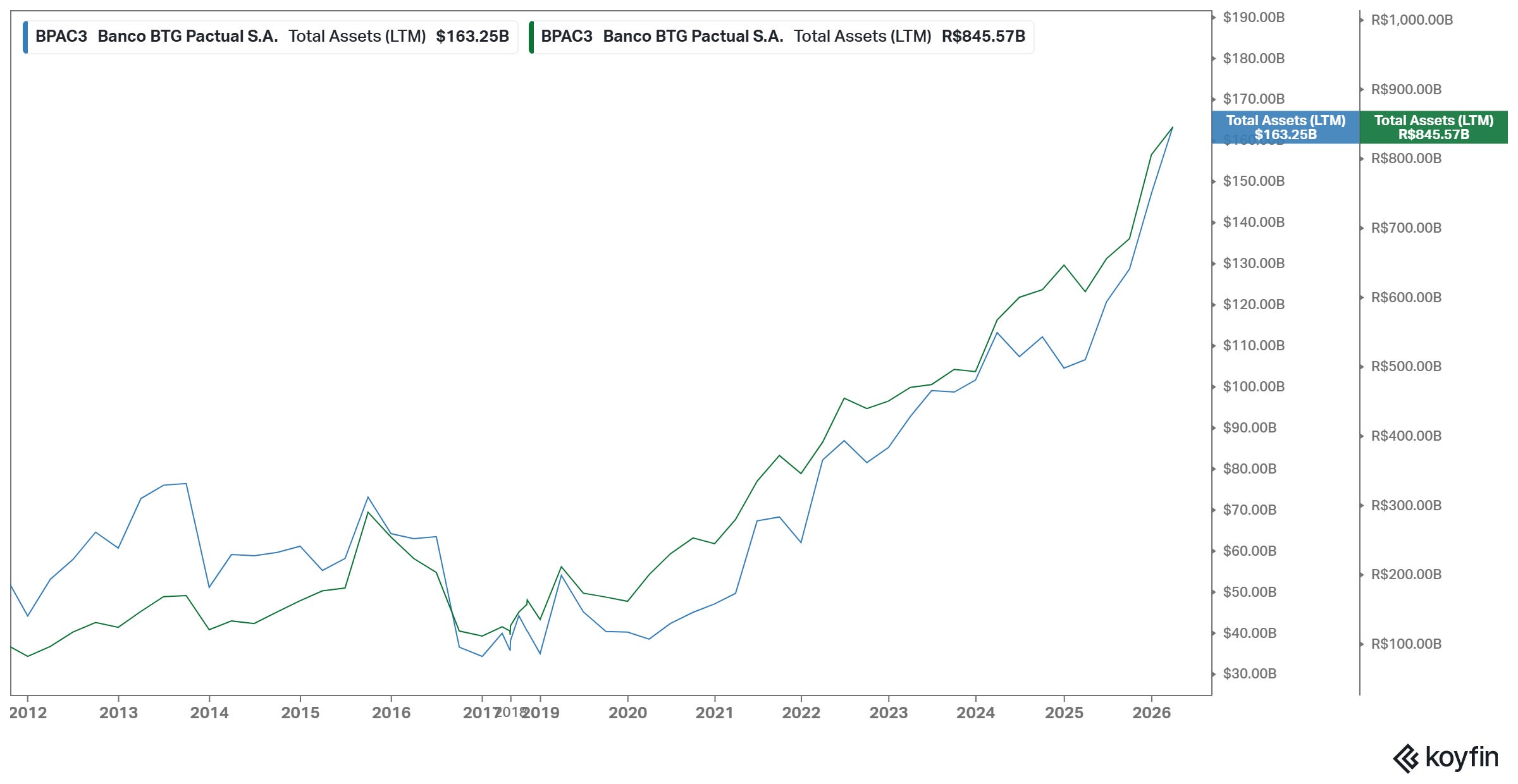
Indeed, BTG has been required to find space for a lot of capital. Its assets have more than tripled in USD and quadrupled in BRL since the pandemic.
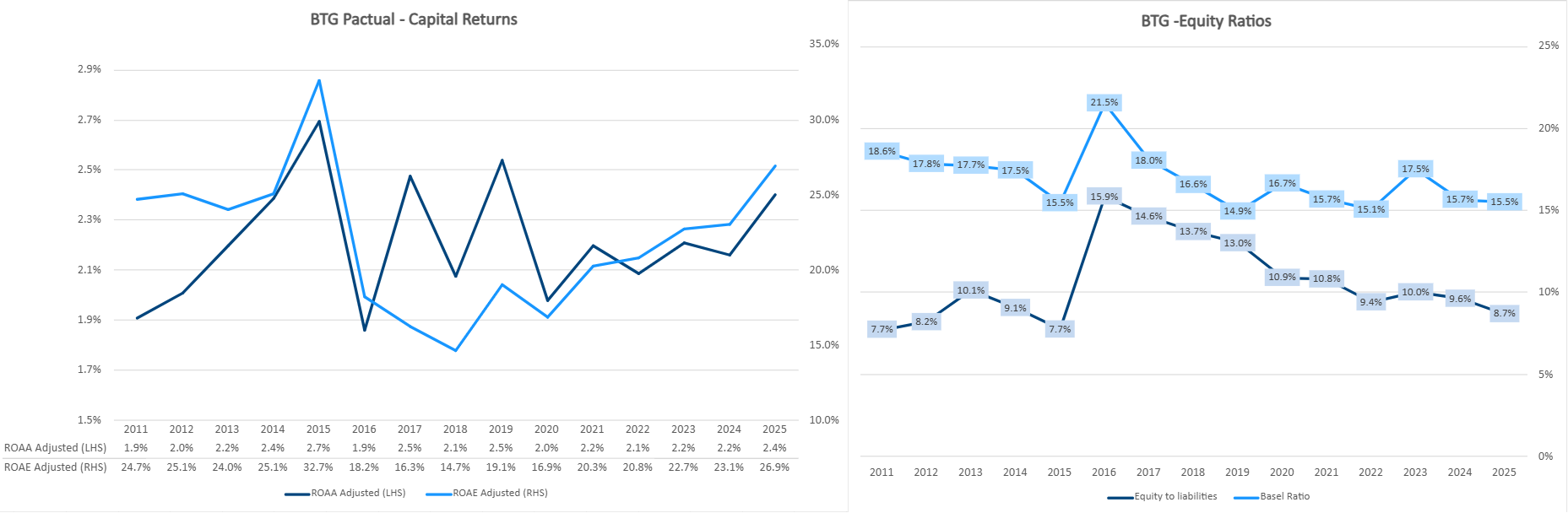
This expansion in assets has been a relevant factor in its growth in ROE. Whereas, as seen below, ROAs are flat since 2017, ROE has expanded by 10 percentage points. The reason can be found in consistent leveraging, with equity/assets ratios almost halving. Additionally, higher rates impact equity more than assets because equity absorbs all of the rate change, whereas assets only absorb the spread widening.
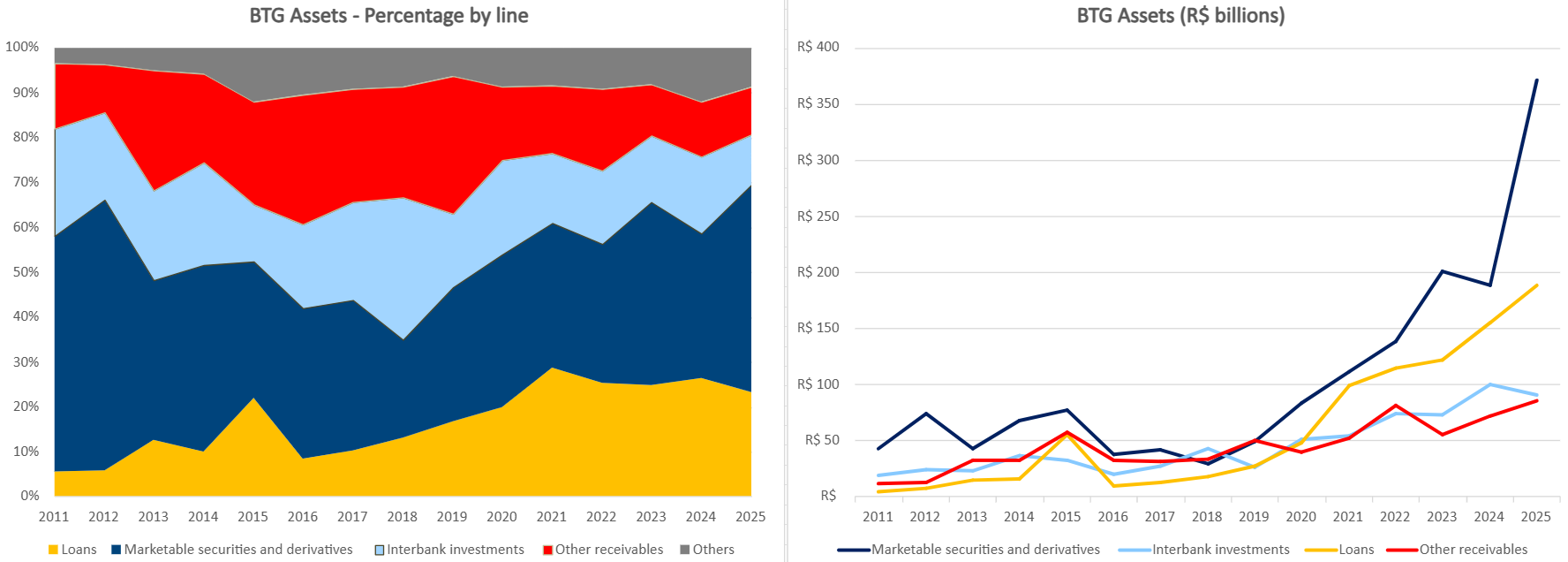
These assets have found a home in loans and securities, part of which are themselves forms of lending, like bonds. The increase in loans has contributed to the growth of Corporate and Consumer Lending in revenues, whereas securities are primarily serving as part of Interest & Other, which could also be called Treasury.
Segment capital returns and cycle exposure
Besides revenue per segment, BTG’s reporting is very scant when it comes to disclosing the profit contribution, capital requirements, and capital returns of each of its businesses.
We can, however, do our estimations and speculation.

