
Brazilian microcap deep value
Six 5x P/E companies: deep value or value traps?

The Brazilian stock market has been taking a huge dip since its earlier, fairly impressive start of the year.
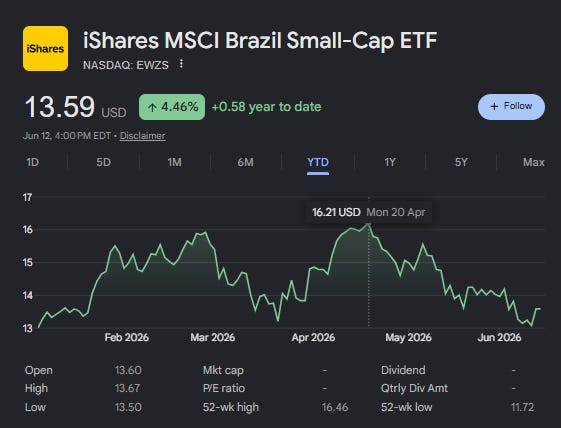
In addition to this, the investable universe of Brazilian-listed stocks is now much larger, at least for me, given that the B3 is now accessible to foreign investors through IBKR.
I have been looking at names screening for cheap valuations mainly. Most of them sit comfortably in the micro cap region (~$80 to $300 million market caps), and could be classified as deep-value, trading at MSD PE multiples or even LSD EV/EBIT multiples.
However, as always with such companies, the devil is in the details. Sometimes earnings are not really recurrent or durable, or there are hidden balance sheet factors, etc.
This article is a selection of six names that caught my attention the most. My analysis tries to acid-test the apparent cheapness of each name, focusing on risks and hidden factors.
Hope you guys like it.
Disclaimer: The opinions expressed in the Blog are for general informational purposes only and are not intended to provide specific advice or recommendations for any individual or on any specific security or investment product. I may own or later purchase the stocks mentioned in this article.
Index
Valid Soluções- $VLID3 - R$1.4 billion
Wiz Co Participações - $WIZC3 - R$1.2 billion
Dexxos Participacoes - $DEXP3 - R$820 million
Allied Tecnologia - $ALLD3 - R$500 million
Qualicorp - $QUAL3 - R$430 million
Meliuz - $CASH3 - R$420 million
Valid Soluções- $VLID3 - R$1.4 billion
Large player in ID and documents (Brazil), mobile SIMs (global), and credit cards (Brazil and Argentina). Some of the businesses are pressured from competition (payments) and others by technology (payments, mobile). Trying to switch towards more digital revenue, it's not easy.
Their businesses seem to be in a neutral to negative position. Growth will be hard/expensive, and there’s always the risk of cannibalization/obsolescence.
Although the name screens cheap (PE of 5/6x), in reality, its earnings power is closer to a PE of 8x.
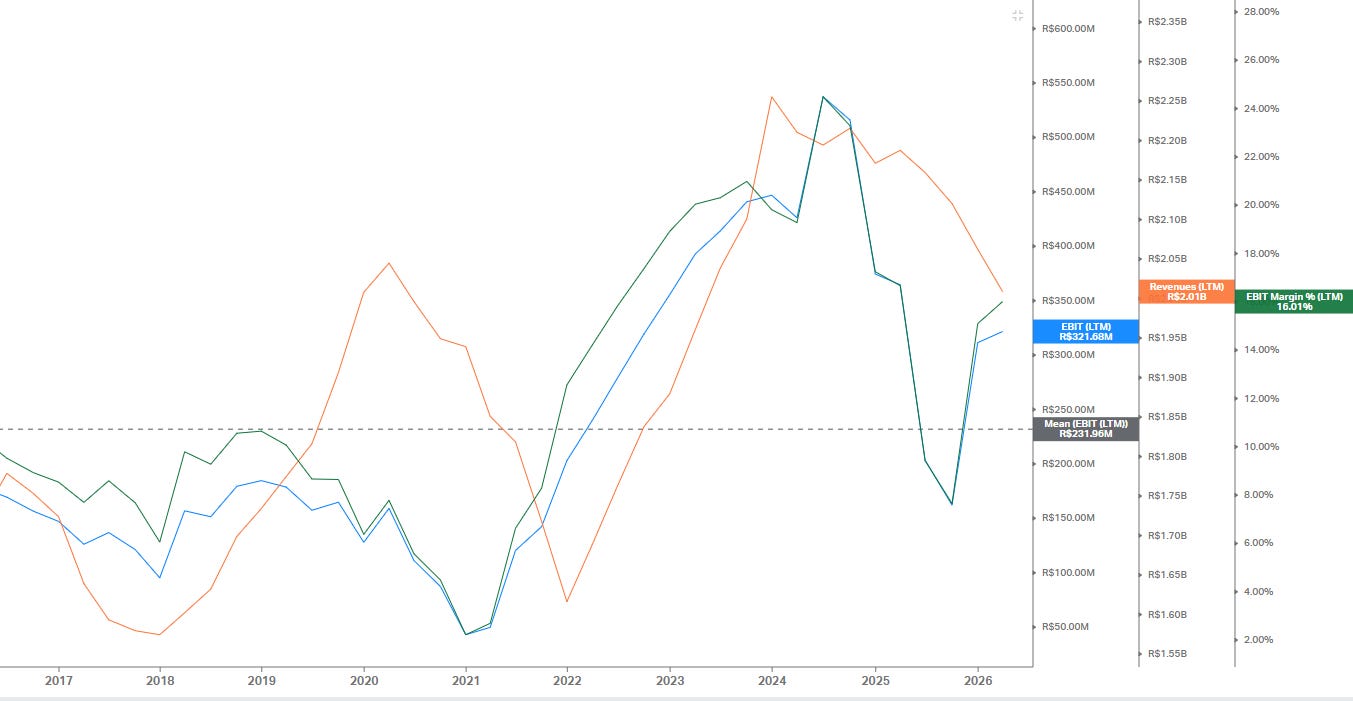
At first sight, Valid seems like an easy thesis: “Good margin businesses pressured by technology, already showing signs of that impact, very discounted PE for that reason, falling knife business”. My read is very similar, only that the PE is actually not that discounted.
Businesses and perspectives
Valid’s operates in three main segments, all related to hardware-based security, and digital infrastructure related to that
Identity and documentation (50% of revenues, 75% of EBITDA)
One of the largest processors of IDs and driving licenses in Brazil. The business is based on government bids. Adjacent legacy businesses include the issuing of securitized documents (anti-forgery and such characteristics).
The company is also expanding into other government areas like digital certificates, smart cities, and is trying to enter other identity-management software-based services like KYC and authentication. This seems harder to do, particularly for B2B.
The segment seems relatively stable, because even though the physical portion might disappear, the digital portion still requires a physical interaction, relationships with governments, etc.
Mobile, SIMs (~30% of revenues, 25% of EBITDA)
10% of the global market share of physical SIMs, one of the top 4 global players.
This business is still recurring and has a good margin (EBITDA 20%) even though it is probably quite commoditized and competitive.
The company is moving towards eSIMs, but this represents a huge change for clients (SIMs are purchased by the network operator, and eSIMs by the phone manufacturer, with software sold to the network operator). It is unclear if the company has that much scale to compete in eSIMs.
In terms of additional SaaS-type revenues for the management of SIMs and eSIMs, it might be a source of certain protection with network operators because of switching costs and embedded technology, but it does not seem like a source of profitable growth.
In aggregate, then, a business that works today but has a Damocles sword on its head coming from the full replacement of physical SIMs.
Payments (20% of revenues, 0% EBITDA).
The original business of the company recently focused on credit card issuance in Brazil and Argentina, but before that, on all sorts of secured payment objects like bills, cheques, etc.
The business was doing ~R$200 million in EBITDA (30% of the company at the time. However, margins got really pressured from competition, mainly from Argentina's opening its trade borders.
Today, it is marginally profitable, or EBITDA breakeven. The segment is responsible for the revenue and EBIT decline between late 2023 and today. It is a sign of what can happen in other segments, mainly mobile.
Balance sheet, capital allocation, profitability, PE
Today, the company has a small net cash position (R$50/100 million), and probably a zero position when we consider debts from acquisitions (which Brazilian companies tend to classify as ‘payables’ for some reason).
Despite the net cash, the company still faces R$60/80 million in net financial expenses per year, because of non-debt interest (discounting of receivables, supplier financing, derivatives), not all cash-yielding interest (working capital uses), etc.
In terms of CAPEX/D&A, the figures are more or less similar (~R$130 million). The company says only R$50 million of that is maintenance, but given that they are building businesses, I would not count the rest as just growth, but potential future maintenance.
The company did R$440 million in EBITDA on a TTM basis, which again, seems ‘stable with risks’. From that, we remove ~R$200 million in interest and CAPEX to get to R$240 million. Up to this point, the calculation doesn’t differ from the company’s financials.
However, the company’s TTM tax rate is not sustainable. On a TTM basis, the company records a net tax credit, which is the result of JCP (see below), and other adjustments. Assuming the tax rate is indeed lower than the Brazilian corporate tax rate (25% instead of 30/35%) but is still a positive tax rate, we get to R$170 million in net income, a PE of 7.5x, not 5.5x.
Positively, the company makes heavy use of JCP (juros sobre capital proprio, interest on own capital), a way of distributing dividends that reduces its tax bill (the dividend is considered interest for tax purposes). Dividends have been close to R$100/130 million in recent years, close(r) to where I see profitability.
Wiz Co Participações - $WIZC3 - R$1.2 billion
Insurance broker focused on bankassurance, with exclusive partnerships with several banks (BMG, BRB, Inter, Parana), along with healthcare insurance (OMNI) and car dealerships.
Although the name seems cheap at ~5/6x earnings, almost the totality of the profitability comes from a single run-off contract with Caixa Economica Federal, lost in 2021, and slowly shrinking. The remaining operation is barely profitable.
Because the company pays most, if not all, profits as dividends (implying a ~15/20% yield), it might still work if the Caixa business lasts for another 5 years, but this is not easily determinable.
Wiz Co is another one of those names that seem like “cheap because of challenges” but actually ends up being “not cheap, still challenged”.
The company focuses on insurance brokerage, with a focus on bankassurance, based on usually exclusive partnerships for the commercialization of insurance with banks. These are structured as JVs, over some of which Wiz has control and consolidation, some not. The most important today are Inter (unconsolidated, 40% ownership), and BMG, BRB (consolidated, ~50% ownership).
Wiz also participates in a similar fashion with exclusive brokerage in dealership businesses (Wiz Conseg) and as a partner in the commercialization of health insurance (OMNI). The company also sells without exclusivity to companies (Wiz Corporate) and operates other service segments like co-brokerage.
I won’t dwell too much on the businesses, because it is not the focus of my rejection. The businesses are ok, some of them (Inter, OMNI) are growing quite a lot. They generate good profitability margins (as much as 10% net on the premiums generated). They do suffer from credit cycle exposure, because a lot of bankassurance is sold with credit (say housing, vehicle, personal life, etc.).
What matters, however, is that the consolidation of the JVs makes it kind of hard to understand where the company actually makes money from, and once that is known, the price is too high for the remaining portion.
Up to 2021, most of the company’s business came from being the exclusive broker for Caixa Economica Federal, the top 2/3 bank in Brazil, and the leader in housing. Being the exclusive broker for such a bank is basically a license to print money. There is a big captive population, and in some forms of credit, life insurance is mandated, etc. It’s just beautiful.
Unfortunately, the company lost the bid for the renewal of the exclusivity license, and today, all that remains are the revenues from previously signed contracts (R$188 million net in FY25). Because there is no further servicing/operations involved, this flows directly from the subsidiary as net profit (R$175.5 million), but the company recognizes it as revenue nonetheless.
If we look at it from the perspective of revenue alone, the Caixa operation is not that important. Maybe 15/20%, and shrinking. So the company shows in its materials.
However, because this “revenue” is pure profit, the Caixa operation is basically all of the company’s profit. This is evident when we look at the ‘Controladora’ level (i.e., before any consolidation, treating all investments as equity method).
The operating JVs, with all the banks and other partners, generate a good profitability, R$230 million last year, and are growing. However, if we had to pay all the WizCo corporate expenses from this (~R$220 million, including CoGS, SG&A, others, and interest), there’s basically no profit left.
Here is where the net revenues (~R$188 million net out of R$215 million shown above) come in and save the day. These revenues are fully consolidated even at the ‘Controladora’ level because the Caixa operation is fully owned.
If we removed these revenues, or the whole net profit from the Caixa operation (R$175 million), the profitability at the parent level (what we care about from the perspective of the common) would fall to R$25 million.
The company pays most of its profits as dividends, meaning it would still work as an investment if the Caixa business lasted 5 years, repaying itself, and then leaving whatever is left for free.
Unfortunately, I could not find comments from the company about how long the contracts from Caixa will last. It is not falling fast, maybe 5% per year. However, I am not sure of that. The revenues have a cut-off origination date (2021), meaning they could also fall quite unexpectedly.
Dexxos Participacoes - $DEXP3 - R$820 million
A chemical business focused on resins, mainly for the wood products industry, doing ~R$200 million in EBITDA, is quite stagnant.
A steel tube processing business that has been shrinking since 2021, and has now entered EBITDA losses territory.
CAPEX of R$60/80 million a year, with a focus on steel. D&A is lower at around R$35/40 million.
Low net cash (R$32 million), enough for no net interest, or a slightly positive one.
The earnings range is probably around R$80 to R$180 million.
Paying dividends and doing repurchases.
Dexxos has two industrial businesses (resins and steel tubes), which depend on further industrial uses (wood products and O&G/construction, respectively).
In both cases, their cyclical position is not incredible right now. Chinese overcapacity pressures both businesses, and Brazil is not particularly undergoing an industrial boom because of the rate environment.

Resins
Dexxos chemical business is focused on resins (650 thousand tons of capacity) and formaldehyde (450 thousand tons).
These products serve the domestic engineered wood products industry (MDF, particleboard, OSB) primarily. As reported by IBA, this is an industry focused on the domestic market, particularly furniture and cabinetry, that has not been growing much. It is clearly an industry being hit by overcapacity in other regions (mainly China), as explored in detail in the Forest Industries articles.
The resins that Dexxos sells cannot be transported long distances, and the company does not get direct Chinese competition. Rather, competition in engineered wood products ends up affecting upstream demand.
This segment, therefore, depends indirectly on the global industrial balance in China. The recent Hormuz challenges might represent an opportunity if surplus exports are reduced.
The company also has a 40% unconsolidated stake in a JV with Petrobras called Copenor that participates in the same segment. Its profitability share has been ~R$15 million per year in 2024 and 2025 (higher in 1Q26 but seems non-recurring).
Recently, Dexxos was forbidden by the O&G regulator in Brazil from trading methanol (a precursor of resins). The impact on revenues was high in Q1, but in gross profitability it was quite low.
Steel tubes
The company also produces steel tubes. The segment works primarily with onshore O&G in Brazil (some sales abroad to the US that decreased even more with tariffs), and construction, including solar panel installations.
Although O&G in Brazil is booming, this is concentrated in the offshore sector, which it seems the company does not serve, or at least not so strongly. Most of the onshore fields in Brazil are quite mature and in recovery.
The segment seems to have gone through the classical cycle of basically all commodities since COVID: very good profits during the supply chain disruptions, and then a small trickle down.
Currently, steel has generated negative EBITDA for 4Q25 and 1Q26. The company is investing most of its CAPEX in the segment and has launched a new coated technology that it says no other company in Brazil offers.

I am not entirely clear about whether this segment faces the same exposure as chemicals, i.e., Chinese overcapacity competing directly in this case, or if it is more related to its downstream markets (onshore O&G and solar panel installations) being depressed.
Balance sheet and capital allocation
The company is in a good capital position, with R$360 million in cash and securities versus R$260 million in debts, and almost R$600 million in working capital assets versus $300 million in all other liabilities.
The company therefore generates no net financial interest/expenses, or slightly positive. There can be variations in foreign currency exposure via derivatives or working capital (payables to foreign suppliers).
Dexxos is increasing its payout ratio, which reached ~40% last year, and is now repurchasing stock (up to 3 million or R$21 million authorization). In 2024, it returned ~R$60 million, and in 2025, R$110 million.
I do not believe the company generates the cash to sustain those dividends and CAPEX in the region of R$60/80 million (compared with D&A of R$35/40 million), especially under current conditions of EBITDA (~R$200 million or less).
Profitability range
We can work with a wide range.
Starting with R$200 million in EBITDA from the whole operation, and considering that R$80 million in CAPEX is actually the minimum needed for maintenance, plus 30% taxes, we get to R$85 million in ‘net income’.
This is representative of the current relatively depressed position in chemicals and the terrible position in steel. Chemicals could get worse if the Brazilian consumer gets worse, and there is no improvement in the Chinese overcapacity pressure in wood products. Steel could get worse, too, but in this case, it is quite possible that CAPEX decreases.
The ‘upper range’ would be R$300+ million in EBITDA, mainly from a recovery in steel, but could also come from a reduction of Chinese pressure in woods and chemicals upstream. Further, the upper range considers that D&A is more representative of maintenance CAPEX, so ~R$40 million. After 30% taxes, we get ~R$180 million.
Allied Tecnologia - $ALLD3 - R$500 million
Consumer technology distributor. Low margin business with significant discretionary and foreign exchange risk.
The company screens cheaply only because of significant Other Operating Income/Expenses. Underlying earnings power is probably ~R$50M per year.
The company has recently paid dividends and capital distributions well above its earnings power (~R$500M for the past two years). This can obviously not continue.
Similar to $WIZC3, I won’t delve much into the business of the company, given that the main reason to look into it is the low multiple, which ends up not being real.
Allied is a consumer technology distributor. They claim to be the largest in Brazil, moving 6 million products per year. The market is obviously highly dispersed because they also claim ~10% share in the main consumer categories (cellphones, notebooks, game consoles).
The company also has a retailing operation managing about ~100 branded Samsung stores. Retail represents ~50% of their revenues and 60% of gross profits. Without segmentation, the operating income share is hard to know, but I would argue much lower than for gross profits, given the higher SG&A burden of retail.
As seen below, since the end of the post-pandemic boom, the company’s margins have been fairly pressured. Operationally, the business is negatively exposed to the consumer cycle, and also to foreign exchange rate depreciation, because of the impact on consumer electronic costs, potential lower margins for a while, etc.
The company posted earnings of R$330 million in 2025 and R$145 million in 2024, both very interesting for its current market cap.
Unfortunately, in both cases, non-recurring factors represent the bulk of earnings. In 2025, non-recurring tax gains represented R$400 million, and in 2024, around R$60 million.
Removing these, the company may earn R$100/150 million in operating income. If we remove an additional R$70/90 million in interest, the pre-tax profitability falls to R$40/50 million.
The company’s balance sheet is not too bad, with ~R$300 million in cash and R$420 million in loans. It is not the strongest balance sheet either for a business with this kind of cyclicality. The company paid regular dividends (JCP) and extraordinary dividends for R$550 million in the past few years.
Qualicorp - $QUAL3 - R$430 million
Collective health insurance broker (plano de saude coletivo). Has been losing clients, revenues, and profits since the pandemic. Potential stabilization in the past few quarters.
Via cost-cutting, it has been able to grow profits despite the lower revenues.
When adjusting for non-cash factors (amortization of past commissions versus what is capitalized today), the company trades at <4x FCF.
Modelling the potential profitability of the company once the portfolio is stabilized at a lower level, it still produces a 5x P/E ratio.
Risks
Obviously is a falling knife. Without topline recovery, it is unlikely that profitability can be sustained
Macro Brazil, given that most of their customers are self-employed people, liberal professions, small business owners, etc.
Internal factors may have caused their problems. The model might simply not provide value to customers.
High levels of debt (~R$900 million net, albeit decreasing) imply low returns to shareholders over the medium term future.
Qualicorp is a broker and manager of collective health insurance packages (planos de saude coletivos por adesão).
This type of health insurance is part of the private insurance ecosystem in Brazil, focused on the liberal professions and other professional groups, with 5/6 million insured (about 10% of the private insurance market). Instead of buying insurance as an individual, people can obtain lower prices from their collective or association (usually of a liberal profession, or some other class like students, or public employees). Qualicorp partners with these associations to broker and manage their health plans. It does not offer the insurance itself, but only manages it for the association.
As seen above, the model of the company has been very challenged on the topline since the pandemic. There are macro and internal reasons.
The macro reasons, in my opinion, in decreasing order of importance:
There was a jump in insurance losses, rendering insurers less willing to enlarge their cohorts at any cost. Insurance, therefore, became more expensive for everyone.
Registered employment expanded greatly, leading to a lot more growth in corporate and company-based insurance, which is not an expense out of pocket for the individual.
The liberal profession middle classes may have felt a squeeze between the high-rate environment and fiscal policies more focused on the poor.
The myriad of professional associations that compose this market are probably losing power and attractiveness. In some sense, they are remnants of a more corporation/guild-based XXth century world.
This all led to the halving of the insured portfolio, as shown in the image below. The yellow bars (Portfolio Adesão) represent the economically most important full-insurance model, called Affinity Managed Portfolio, whereas the blue bars (Portfolio Core) include other, less profitable coverage, like dental, SME coverage, etc. The only important portion is the Affinity Managed Portfolio, as it represents 97% of revenues.

Still, not all is the market. One potential question mark, which would indicate primarily internal problems, is the fact that since 2021, the whole market for Adesão has barely fallen, only 10%, and by 500 thousand participants, exactly what Qualicorp has shed.

Another internally-pointing question mark is that the company has faced massive lawsuit losses, jumping from R$26 million in 2022 to R$108 million in 2025, stemming from unilateral cancellations of plans, which seem to involve fake association members (not permitted by law) and risk selection (also not permitted).
Finally, the company’s churn levels are massive, about 50% per year. This can be indicative of severe value proposition challenges. People sign up, but quickly realize the plan is not so valuable. The high churn might also be caused by the nature of the category, geared towards people not working for a company, who may either find employment-provided insurance or face other economic challenges.
To the topline pressure, we have to add a fairly leveraged operational cost structure, with about half of the cost structure considered fixed, and a model of depreciated commissions over the expected lifetime of the customer. With sudden falls in lives in 2023, you also get impairments on capitalized commissions, etc.
The recent recovery in EBIT has come from the cost side as well, via a 50% reduction in fixed costs (personnel, G&A, marketing, 3rd-party services). The company has also reduced commission expenses to one-half of previous expenditures, obviously impacting gross incorporations in the process, though.
Interestingly, the expenses classified by the company as ‘variable’ have anything but varied. The category remains at around ~R$400 million per year, even though the portfolio fell by 50% in the period.
The reason behind this is again the judicial expenses coming from cancellations, requests for coverage of treatments, etc. These types of judicial expenses have been a challenge for other health insurers, especially on the low-cost side (see Hapvida, for example), but as mentioned, they might show an internal problem in Qualicorp. So far, they show no sign of decreasing.
We should also consider that amortization is almost 2x the current investments of the company. A small portion of the difference comes from the accrual recognition of commissions (although only a small portion, as amortization and investment are close now), and another small portion comes from other intangibles, like exclusivity rights, software, etc.
The question is, will the company’s earnings and portfolio stabilize at some point? What kind of profitability will be generated at that point?
I believe we can use a model to analyze that, based primarily on the Affinity Portfolio (responsible for most of the revenues):
The cost to acquire a client today is around R$800 (cash commission costs over gross additions).
A client today generates ~R$250 per quarter in adjusted EBITDA (adjusted EBITDA / total members at the beginning of the period).
This figure has risks because the profitability of a cohort signed up today can be lower than the profitability of the cohorts generating revenues and profits today. However, given a high churn level (40%), the value of each cohort should be quickly realized on the income statement. The adjusted EBITDA/customer profile has not been volatile. Furthermore, the figure includes the legal costs of previous cohorts, and therefore could actually increase down the road if judicialization decreases.
With a quarterly churn of 12%, the lifetime of a customer is 8 quarters, or 2 years. Throughout this period, the customer generates R$2,000 in adjusted EBITDA. Minus the R$800 needed to get the customer, we are in R$1,200 adjusted EBITDA - CAC profitability levels over two years, per customer, or R$600 per year.
The only expenses not considered in adjusted EBITDA are commission amortization (we are replacing it with cash commissions per customer) and intangible amortization, for which the company has invested ~R$30 million a year versus amortization of R$30 million per quarter.
We also need to consider where the company’s portfolio might stabilize. Given that the company has acquired ~40 thousand customers per quarter over the past year, and that churn is 12% per quarter, the portfolio would stabilize at 480 thousand customers, versus 520 thousand today.
At 480 thousand customers, the company would be generating an operating profitability (excluding intangibles amortization but including commissions) of R$288 million per year (R$258 million including R$30 million of investment in intangibles).
From this we have to remove R$170 million in net interest expenses and taxes of 30% (potentially a slightly lower rate because of excess amortization). We reach a potential stabilized profitability of R$82 million.
This still seems attractive compared to a R$430 million market cap.
Still, the company is not in a position to pay that profitability as dividends or repurchases just yet.
Between 2024 and 2026, it reduced gross debt by R$520 million, and it currently has a net debt of R$900 million (R$1,800 gross debt versus R$985 million in cash and securities). The company also lists ~R$550 million in “other financial assets”, which I believe are mostly working capital (payment differences with insurance companies, prepaid expenses, etc.).
Key questions that remain are whether the portfolio can truly be stabilized at around ~480 thousand members and what the profitability of that portfolio will be. Further, even if that was the case, reducing the debt to more manageable levels would still take a few years.
Meliuz - $CASH3 - R$420 million
Disclaimer: I own shares of Meliuz.
Cashback business app generates R$100 million in EBITDA.
Has R$90 million in cash and securities, ~R$200+ million in BTC, and all liabilities are covered by receivables.
Risks: the operating business shrinks in a more pressured consumer cycle; the company has to find a new bank partner for some banking services before mid-2027.
Meliuz owns a famous and well-reviewed cashback app in Brazil with the same name and has recently become a BTC Treasury company.
The company’s public history is quite disastrous, IPOing at a R$1.5 billion, 10x sales valuation in 2020 (things that could happen in the bubble), doing several acquisitions that didn’t work, and losing loads of money in aggressive growth in an attempt to diversify into fintech.
Then the company restructured, focused on the cashback business alone, cut costs, returned half of its capital to shareholders (R$400 million in 2023/24), and became EBIT profitable in early 2024. Since then, both revenues and profitability have continued to grow, with very good operating expense leverage.
In March 2025, the company launches a BTC Treasury strategy, raising R$180 million and purchasing 600 BTC at a price of about $100 thousand each using funds from the raise, net cash they already owned and cash flows.
The cashback business
Meliuz's operating business is the app of the same name, ranking number 7 in the e-commerce ranking in Brazil. They claim to have 52 million registered users, 11 million added last year.
The app partners with retailers that offer cashbacks and other forms of discounts. When the user selects a partner, it is redirected to the partner’s website, and when he makes a purchase, he receives the cashback in the Meliuz app. That cashback can be used within the app for other purchases or sent as real cash to another account. Meliuz can also recognize cashbacks from selected physical purchase receipts in order to work with offline partners, like supermarkets.

The app has very good reviews online; you can check dozens of YouTube videos, with lots of comments saying that the system works just fine. For the partner, the app works as an acquisition channel.
The only thing that rings a bell for me is the accounting decision to treat the whole thing as principal rather than agent. In my mind, it would make sense for the partner to select the promotions and pay a variable or fixed fee for traffic generated in the app. I guess this is how it works, but the company recognizes the cashback component as both revenue and an obligation to the app user.
This business probably has consumer cycle exposure, depending almost entirely on the customer acquisition budget of the retailers. If the consumer is weaker, it is possible that the ROI of the cashbacks decreases, which leads to offering fewer cashbacks/promotions, and therefore to making the app less attractive for users.
Adjacent businesses
The company also recognizes revenues from its Shopping segment from other similar businesses, including NotaFiscal (the ability to scan receipts, which is basically the same as the app but offline), Meliuz Prime (premium user with higher discounts), Ads, and cellphone top-ups. It now represents about 20% of Shopping revenues, and is growing faster than the original business, but the company does not report which sub-segment is the one growing. I would suspect it is either Ads or NotaFiscal.
The company also has a Financial Services segment, offering a digital account and a co-branded credit card. It has a smaller user base (5 million digital accounts, ~300 thousand credit cards), and the infrastructure and credit risk are managed by Banco Votorantim. Meliuz only makes a profit from commissions on account creation, balances, TPV, etc. A few years back, the company tried to bootstrap its own fintech offering and lost a lot of money in the process.
The company has recently announced that Banco Votorantim has decided to end its partnership with Meliuz. Meliuz, therefore, has to find a new partner before mid-2027 in order to keep offering these services.
The business, which generates ~R$40 million in revenues (at probably very high margins, although undisclosed), is probably highly tied to credit conditions. In 1Q26, the business generated 13% lower revenues YoY, and credit card TPV fell by 25%. Because credit limits and card issuance are determined by the partner bank, this ends up affecting the segment results.
Meliuz also records an ‘Others’ segment, which includes several subsidiaries generating around R$40 million in yearly revenues. The primary one, responsible for 80/90% of those revenues, is Melhor Plano, another acquisition channel business focused on comparing telco services, credit card conditions, etc.
The company also consolidates 50%+ of a Polish e-commerce business it acquired in 2021 (Picodi). This represents only 5% of revenues and a negligible operational loss.
Operating leverage
The company’s self-classified fixed expenses are ~R$130 million per year (R$110 million exclusive of D&A, which is mostly previous acquisition amortizations). Their cashback margin is around 55/60%, and they spend ~10% of revenues on marketing, probably at a variable rate because of churn.
This implies a required revenue rate of ~R$290 million, or a decrease of almost 40% from current operational levels, inclusive of Financial Services and Others.
Balance sheet and BTC
As mentioned, as of 1Q26, the company has R$91 million in cash and securities, and 604 BTC, which at current prices (early June 2026) represents about R$200 million more. Receivables and other working capital assets are another ~R$100 million, and total liabilities, which include no debt, are R$91 million.
Risks, shenanigans
Exposure to the consumer cycle in the cashback business
Exposure to the credit cycle in the financial services business
If the company does not find a new banking partner, it might be that the whole financial services business is at risk, and potentially (I am not sure) some additional functions from the cashback business, like PIX payments (maybe not though).
The company launched a covered BTC put strategy in September 2025, but does not record its notional value or exposure as of March 2026.
The minority owners of the Polish business (Picodi) claim that they should be bought out for R$70 million. Meliuz claims that the minority put option’s covenants were not met.


